From Mama Lawi to CartFlow
The same wisdom. A new way to shop together.
5 July 2026 · CartFlow Editorial
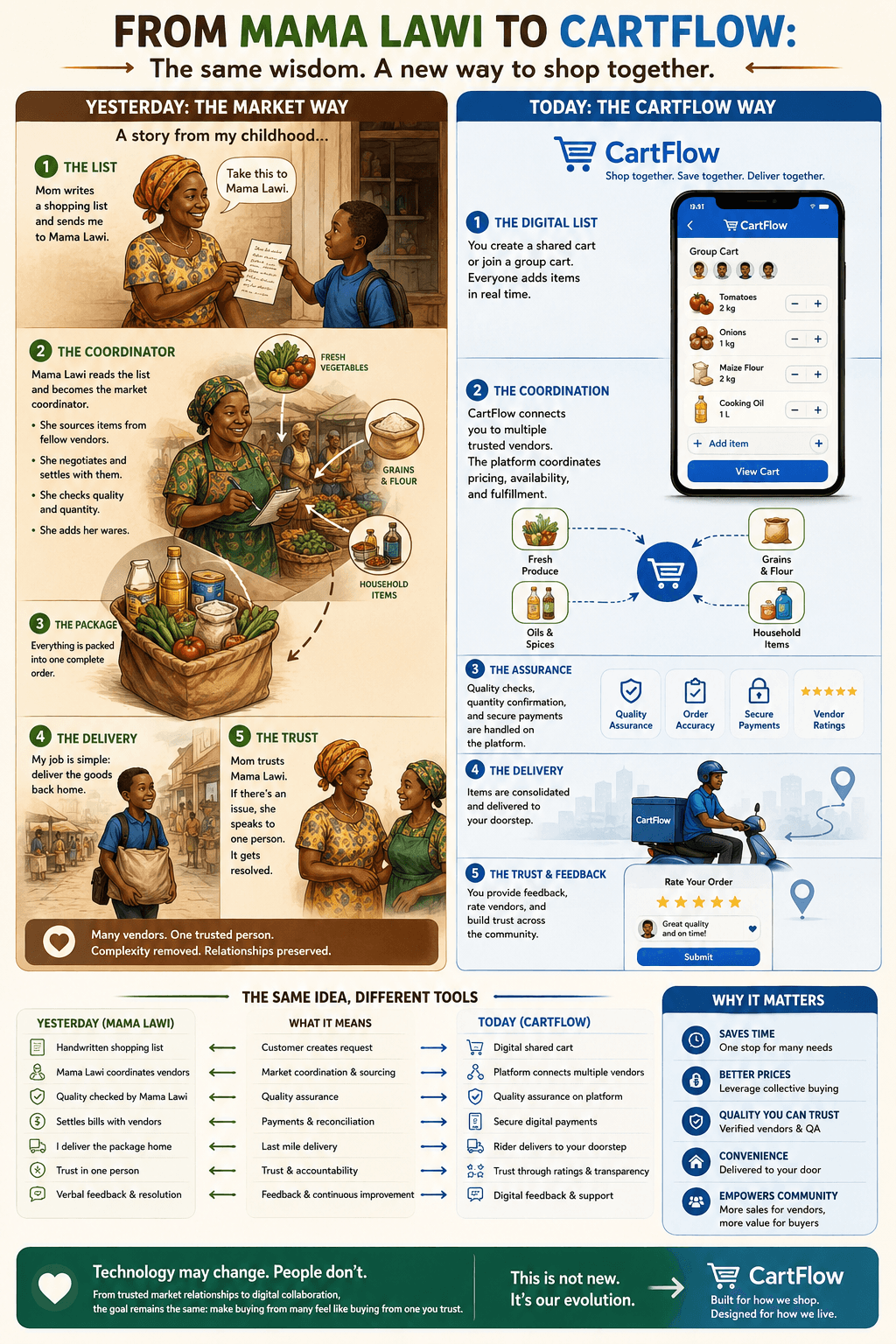
Author's note: Mama Lawi is a composite character inspired by market coordinators, mama mboga networks, and neighbourhood buyers across East Africa. The story is illustrative, not biographical.
The boy with the list
Every Friday morning, the same ritual unfolded.
Mother would tear a corner from an exercise book — the one with the ruled lines still faintly visible from last term's homework — and write in her careful hand: two kilos tomatoes, one tin maize flour, half kilo onions, cooking oil if the price is fair. She folded the paper twice, pressed it into her son's palm, and said the words he had heard since he was small enough to hide behind her skirt at the market:
"Take this to Mama Lawi. She knows what we need."
He did not go to one shop. He did not compare prices on a phone he did not yet own. He walked past the bodaboda stage, down the lane where the smell of frying mandazi mixed with ripe mangoes, and found her — Mama Lawi — seated where she always sat, between the vegetable stall and the grain merchant, a woven basket at her feet and a pencil tucked behind her ear.
She was not, strictly speaking, a vendor. She sold some things herself — onions from her cousin's shamba, eggs from a neighbour's layers — but her real trade was something harder to name and impossible to replace. She was the person who made many vendors feel like one.
Many vendors. One trusted person. Complexity removed. Relationships preserved.
That sentence is not marketing copy. It is the operating manual of a commerce system that predates smartphones, predates M-Pesa, and predates every startup pitch deck that ever used the word "disruption." It is also the story of what CartFlow was built to preserve.
Yesterday: The Market Way
To understand Collaborative Commerce, you must first understand that Mama Lawi was running an operating system. Nobody called it that. Nobody filed patents. But every step she took followed an architecture so consistent that once you see it, you cannot unsee it — in chama bulk buys, in estate WhatsApp groups, in church procurement committees, in farmer cooperatives loading one lorry for three villages.
Step 1: The list
Commerce begins with aggregation. A household rarely needs one item; it needs a bundle of needs compressed into language — flour, vegetables, soap, something for Sunday lunch. The list is the first API call of collaborative commerce: a structured request sent from someone who needs goods to someone who can orchestrate fulfilment.
In Mama Lawi's world, the list travelled on paper, in memory, or shouted across a compound wall. The medium changed from family to family. The function did not.
Step 2: The coordinator
This is where most Western ecommerce narratives go wrong. They assume the buyer interacts directly with the marketplace. In Mama Lawi's lane, the buyer interacts with one coordinator who interacts with the marketplace on their behalf.
Watch her on a busy morning. She walks to the tomato seller and selects firm, unbruised fruit — rejecting three crates before accepting one. She negotiates with the grain merchant: "My people buy every week. Give me today's price for five families, not one." She checks the cooking-oil shelf, compares brands, adds a bundle of sukuma from her own stock because she knows the Omondi children eat greens five nights a week.
She is performing roles that modern software splits into separate products:
- Vendor discovery — who has quality stock today
- Price negotiation — bulk leverage across households
- Quality assurance — eyes and hands where ratings do not yet exist
- Inventory substitution — swapping items when something is unavailable
Insight: The coordinator is not a middleman extracting rent. In trusted community commerce, the coordinator is the user interface — the human layer that translates messy household needs into clean market outcomes.
Step 3: The package
Individual vendors sell units. Communities buy orders. Mama Lawi's basket is the original shared cart — tomatoes from stall four, flour from the wholesaler, oil from the shelf near the entrance, sukuma from her own table — consolidated into one package with one mental model for the buyer: this is what you asked for, this is what you owe.
The consolidation step is not logistics trivia. It is the moment collaborative commerce creates value. Without it, every household pays the coordination tax separately — time, transport, negotiation, error.
Step 4: The delivery
The boy carries the package home. Last mile, in 1998, was a child with strong arms and a mother watching from the doorway. Last mile, in 2026, is a rider on a scooter with a CartFlow badge — but the function is identical: move consolidated goods from coordination point to household.
What changed is scale and safety. What did not change is that delivery completes the loop between collective buying intent and individual household receipt.
Step 5: The trust
The mother does not inspect every tomato. She inspects Mama Lawi. If something is wrong — short weight, bruised fruit, a price that does not match what was agreed — she does not march to five stalls. She returns to one person. Dispute resolution is centralized because trust is centralized.
This is the feature ecommerce platforms spend billions trying to approximate with ratings, escrow, and buyer protection policies. Mama Lawi solved it relationally: I stake my name on this package.
Pull quote (illustrative): "I don't buy from the market. I buy from Mama Lawi. The market is just where she works." — composite voice, Nairobi estate, circa 2005
The operating system nobody named
Let us name what Mama Lawi ran, because naming creates categories, and categories create clarity.
A Collaborative Commerce Operating System (CCOS) is infrastructure that coordinates group purchasing across six layers:
- List layer — aggregate demand from multiple buyers
- Trust layer — one accountable relationship replaces many anonymous ones
- Vendor layer — connect to multiple suppliers without buyer fragmentation
- Assurance layer — quality, accuracy, and substitution rules
- Settlement layer — collect from buyers, pay vendors, track who owes what
- Delivery layer — move consolidated orders to final recipients
Mama Lawi ran all six in her head, on paper, and in reputation. CartFlow runs all six in software — shared carts, share confirmation, TrustPass vendor verification, Payment Intelligence Platform (PIP) reconciliation, organizer dashboards, and delivery coordination.
The GSMA's research on mobile money in Sub-Saharan Africa documents how digital financial tools succeed when they map onto existing social trust networks rather than replace them. Collaborative commerce follows the same law: technology that ignores Mama Lawi fails; technology that digitizes Mama Lawi spreads.
World Bank work on informal markets similarly emphasizes that intermediaries in traditional commerce often reduce transaction costs rather than add them — precisely because they convert multi-vendor complexity into single-relationship trust. Mama Lawi was not friction. Mama Lawi was infrastructure.
Today: The CartFlow Way
Now scroll forward. The boy with the paper list is a man with a phone. The estate has a WhatsApp group with 200 members and forty unread messages every evening. The chama treasurer still coordinates bulk buys — but now the screenshots of M-Pesa confirmations do not match the spreadsheet, and someone always asks "did you include my sugar?" on Thursday night.
The need did not change. The tools did — and for a while, they made commerce louder without making it clearer.
CartFlow was built to answer a precise question: What if Mama Lawi's operating system had a digital body?
Step 1: The digital list
Instead of paper, a shared cart. Every family in the Greenview Estate group opens the same link — /join/greenview26 in the flagship demo — and adds items in real time. Tomatoes, onions, maize flour. Each household sees the whole list and its own share forming.
The list layer is no longer carried by one boy. It is visible to everyone, which reduces the "you forgot my item" failure mode that kills trust in group chats.
Step 2: The coordination
CartFlow sits at the centre of the vendor network the way Mama Lawi sat at the centre of the market lane — connecting fresh produce, grains and flour, oils and spices, household goods. The platform surfaces pricing and availability; the organizer (today's Mama Lawi — often an estate admin or chama secretary) applies judgment.
Software does not replace the coordinator. It amplifies the coordinator — less time chasing messages, more time on quality decisions only humans should make.
Step 3: The assurance
Where Mama Lawi checked tomatoes with her hands, CartFlow provides structured assurance: order accuracy at lock, share confirmation before payment, TrustPass verification for informal-sector vendors, and reputation signals that accumulate over time.
TrustPass — CartFlow's progressive KYC/KYB layer — exists because Kenya's commerce runs through mama mboga stalls, boda operators, and market associations as much as through formal shops. Verification must match how vendors actually operate, not how a Silicon Valley playbook imagines they should.
Step 4: The delivery
The rider with the CartFlow delivery completes the same loop the boy with the basket completed — consolidated order to doorstep — with tracking, SLA reminders, and WhatsApp delivery messages generated from the organizer dashboard.
Step 5: The trust and feedback
When the order lands, trust becomes visible: ratings, comments, dispute paths, payment receipts reconciled through PIP. The relational trust Mama Lawi carried in her name becomes distributed trust recorded in the platform — transparent enough for new members to join the group cart without ten years of neighbourhood history.
Insight: Digital trust should not replace personal trust. It should carry personal trust across scale — so the estate with fifty new families works as smoothly as the estate with fifty familiar faces.
Same idea, different tools
The infographic at the top of this article captures the mapping in one view. Here it is in prose for readers who learn through text — and for search engines that cannot yet read our illustrations.
| Yesterday (Mama Lawi) | Today (CartFlow) |
|---|---|
| Handwritten list | Digital shared cart |
| Mama Lawi coordinates vendors | Platform connects multiple vendors |
| Quality checked by Mama Lawi | Quality assurance on platform + TrustPass |
| Settles bills with vendors | Secure digital payments via M-Pesa / PIP |
| Child carries package home | Rider delivers to doorstep |
| Trust in one person | Trust through ratings, transparency, and coordinators |
| Verbal feedback and resolution | Digital feedback, support, and audit trail |
Read down the right column and notice something: these are not random features. Each row is the same layer Mama Lawi operated, expressed in software.
That is why CartFlow rejects the label "ecommerce app." Ecommerce optimizes checkout. CCOS optimizes coordination — and checkout is only one subroutine.
Why it matters
The Mama Lawi model was never about nostalgia. It was about outcomes.
Saves time. One coordination point replaces five separate market trips. In estate weekly shopping, organizers report the same pattern CartFlow's estate playbook documents: families spend minutes adding items instead of hours reconciling messages.
Better prices. Bulk leverage is not a modern invention. Mama Lawi negotiated for five families; chama treasurers negotiate for fifty; CartFlow campaigns extend the same economics with visible totals before lock.
Quality you can trust. Assurance is only as good as the coordinator's incentives. CartFlow makes those incentives visible — locked carts, confirmed shares, TrustPass profiles — so quality survives beyond one person's memory.
Convenience. Delivery to the door is not laziness. It is the final step of consolidation, and consolidation is the whole point of collaborative commerce.
Empowers community. Vendors gain volume. Buyers gain leverage. Coordinators gain tools instead of exhaustion. The zero-sum framing of "platform versus people" misses the point: Mama Lawi's model was always win-win when trust was intact.
When phones arrived, commerce got louder but not clearer
Something went wrong in the transition — not because phones failed, but because we asked phones to do the wrong job.
WhatsApp groups became accidental CCOS installations. They handled the conversation layer beautifully — invites, reminders, social pressure to pay, jokes about who forgot the milk. They were never designed for the settlement layer — split totals, partial payments, reconciliation against a locked order, audit trails when someone disputes a share.
The result is familiar to anyone in a Kenyan estate or chama: infinite scroll, conflicting spreadsheets, M-Pesa screenshots at midnight, and the quiet resentment of the one person who always ends up as unpaid treasurer.
CartFlow does not ask groups to leave WhatsApp. It asks them to stop running commerce inside it. Continue the conversation where trust lives. Run the operating system where numbers must agree.
The Greenview Estate demo — five families, weekly groceries, organizer dashboard at /organizer — is deliberately ordinary. It is not a futuristic vision. It is Mama Lawi's Friday, with less chaos.
Insight: The problem was never "groups don't want to buy together." The problem was "groups lacked infrastructure for buying together at scale."
Market Queens, chamas, and estate admins
Mama Lawi is not unique to one city or one decade. East Africa has always had coordinators:
- Market Queens — association leaders who set norms, resolve disputes, and aggregate orders across stalls
- Mama mboga networks — trusted produce brokers who source from wholesale markets at dawn
- Chama treasurers — rotating savings groups that pool contributions and bulk-buy staples monthly
- Estate admins — WhatsApp group owners who become involuntary commerce coordinators every Sunday
- Church procurement committees — event supplies, feeding programmes, building materials
- Farmer cooperatives — one lorry, many smallholders, one invoice
Different names. Same architecture. CartFlow's cart templates — Weekly Groceries, Chama Bulk Buying, Church Event Supplies, Office Supplies, School Shopping — are not product marketing gimmicks. They are recognition that the CCOS runs differently depending on community shape, but the layers stay the same.
The Marikiti-to-Kilimani story in CartFlow Academy makes this explicit: twenty Kilimani families buying from Marikiti Market is the same collaborative pattern at urban scale — share code, shared cart, confirmed shares, coordinated delivery.
Individual shopping is the anomaly
Western retail history trained us to imagine commerce as a solitary act: one cart, one checkout, one receipt. That model is culturally recent and economically expensive for households that already live in networks.
Walk through a supermarket aisle in Nairobi and you will still see coordination in the aisles — a phone call to a spouse, a text to a neighbour asking whether they need milk, a mental tally of what the chama meeting agreed to bulk-buy next week. Individual checkout is the interface; collaborative intent is often the input. The mismatch between how people shop and how platforms are built creates friction that users blame themselves for instead of blaming the software.
Social commerce research consistently finds that purchase decisions in collectivist contexts are socially embedded — price matters, but so do recommendation, reputation, and obligation. A 2016 systematic review of social commerce literature (Zhang & Benyoucef) documents how trust, social norms, and community recommendation shape buying behaviour online in ways that individual-cart models fail to capture. GSMA data on mobile money adoption shows that payment behaviour follows social graphs: people send money to people they trust, often for shared purposes — school fees pooled across cousins, contributions to a colleague's harambee, the estate treasurer's till number saved as "Weekly Shopping."
Put those findings together and a different picture emerges. Collaborative commerce is not a niche feature for "group discounts." It is the default human pattern temporarily disrupted by individual-checkout retail and partially restored by platforms that respect social structure.
Consider the economics plainly. When five households each travel to the market separately, they pay five transport costs, five time costs, and five negotiation costs. When one coordinator aggregates demand, vendors offer volume pricing because their marginal cost of serving one more unit in a bulk order is lower than serving five separate transactions. The savings are real — CartFlow's savings calculator on the landing page models bulk savings, time saved, and delivery savings for exactly this reason — but the deeper savings is coordination cost avoided. Mama Lawi was a coordination-cost reduction engine long before anyone spreadsheeted the word "efficiency."
Trust compounds the economics. In repeat relationships, vendors extend informal credit, hold quality stock, and prioritize orders because default is costly in tight communities. Market Queens and chama treasurers inherit the same logic. CartFlow's TrustPass and commerce trust scores attempt to make that informal trust portable — so a vendor's good behaviour in one estate campaign follows them to the next, the way Mama Lawi's reputation followed her across decades at the same lane.
CartFlow's category claim is therefore not arrogance. It is documentation: CCOS is what communities already run. We are naming the thing so it can be improved, taught, measured, and protected.
Naming the category: Collaborative Commerce OS
CartFlow CCOS™ progresses through stages that mirror how groups mature their coordination:
Shared Cart → Collaborative Shopping → Collaborative Procurement → Collaborative Commerce
A shared cart is the list layer. Collaborative shopping adds members, roles, and real-time updates. Collaborative procurement introduces lock, vendor coordination, and settlement. Collaborative commerce completes the loop with delivery, reconciliation, savings analytics, and trust accumulation across cycles.
Payment Intelligence Platform (PIP) — BizClinic's shared payment service powering CartFlow, ClariFi, Kalenda, and BizKit — sits beneath the settlement layer: Universal Payment IDs, dual-rail M-Pesa (Daraja + KopoKopo), automatic reconciliation. Coordinators should not be amateur accountants. Treasurers should not reconcile screenshots at 11 PM.
TrustPass sits beneath the vendor layer: verify the person, observe the business, score the behaviour — because Kenya's economy runs through informal excellence as much as formal compliance.
Neither feature is bolt-on ecommerce. Both are OS primitives — the way file systems and network stacks are primitives for personal computers.
CartFlow as digital preservation, not replacement
The worst thing we could do to Mama Lawi's legacy is claim we "invented" her.
What CartFlow preserves:
- One trusted coordinator — now an organizer with a dashboard, not a burned-out volunteer with a spreadsheet
- Many vendors, one package — now a locked shared cart with vendor coordination, not a child carrying six separate bags
- Quality staked on reputation — now TrustPass and ratings, not only memory
- Settlement you can explain — now PIP reconciliation, not arguing over screenshots
- Delivery that completes the loop — now tracked riders and WhatsApp delivery templates
- Community conversation where it belongs — still in the group chat, no longer responsible for arithmetic
What CartFlow adds is scale without trust erosion — the ability for a group to grow, rotate coordinators, onboard new families, and still produce Mama-Lawi-quality outcomes.
That is digitization in the honourable sense: same wisdom, new tools.
What changes when CCOS goes mainstream
When collaborative commerce infrastructure becomes as normal as mobile money, several shifts follow.
Estates stop losing treasurers to burnout. Weekly shopping becomes a playbook, not a personality test.
Chamas bulk-buy with locked totals and transparent shares — finance meetings focus on goals, not receipt archaeology.
Schools and churches run procurement with audit trails donors can trust.
Cooperatives and farmers coordinate volume without losing smallholder identity.
Vendors access demand aggregated cleanly — less haggling in DMs, more fulfilled orders.
Researchers and policymakers can finally measure a commerce pattern that previously lived only in ethnography and WhatsApp folklore.
CartFlow Academy exists because OS categories require literacy, not just software. You should not need a computer science degree to run collaborative commerce — any more than Mama Lawi needed one to run the market lane.
Epilogue: Technology may change. People don't
From trusted market relationships to digital collaboration, the goal remains the same: make buying from many feel like buying from one you trust.
Technology may change. People don't.
This is not new. It's our evolution.
If you are reading this, you already know your group's Mama Lawi. Maybe she is your auntie at Marikiti. Maybe she is the estate admin who posts the shopping link every Sunday. Maybe she is you — tired, trusted, and tired of spreadsheets that do not agree with M-Pesa.
CartFlow was built for how we shop. Designed for how we live.
Start a shared cart. /cart/new
Explore the estate demo. /join/greenview26
Learn the workflow. /use-cases/estate-weekly-shopping
Train your team. /academy
Frequently asked questions
Who is Mama Lawi?
Mama Lawi is a composite archetype — not one historical person, but the trusted market coordinator found in neighbourhoods across East Africa. She aggregates shopping lists, coordinates multiple vendors, checks quality, settles payments, and resolves disputes so families can buy from many sellers through one relationship they trust.
What is a Collaborative Commerce Operating System (CCOS)?
A CCOS is the full infrastructure behind group buying: shared lists, trust, payments, vendor coordination, quality assurance, settlement, and last-mile delivery. CartFlow CCOS digitizes each layer while preserving the social trust model communities already use.
How is CartFlow different from a normal ecommerce app?
Ecommerce apps optimize individual checkout. CartFlow optimizes group coordination — one shared cart, confirmed shares, split M-Pesa payments with reconciliation, organizer dashboards, and WhatsApp-friendly workflows for estates, chamas, families, and cooperatives.
Did Africans invent collaborative commerce?
Communities across Africa have coordinated shared purchasing for generations — through market queens, chama treasurers, estate admins, and village buying clubs. CartFlow did not invent the model; it digitizes infrastructure that already existed.
What can I try today?
Start a shared cart at cart-flow.store/cart/new, explore the Greenview Estate demo at /join/greenview26, or read the estate weekly shopping playbook at /use-cases/estate-weekly-shopping.
Why does trust matter more than price in group buying?
Research on informal markets consistently shows that repeat relationships reduce search costs, improve quality outcomes, and lower dispute rates. In collaborative commerce, trust is not a soft feature — it is the coordination layer that makes multi-vendor buying feel like buying from one person.
What does 'Technology may change. People don't' mean for CartFlow?
It means the human need — buy from many, trust one coordinator, preserve community relationships — is constant. CartFlow changes the tools (digital carts, M-Pesa, ratings) but not the underlying social architecture of how we shop together.
Your group already shops this way
CartFlow simply made it digital. Start a shared cart for your estate, chama, or family.